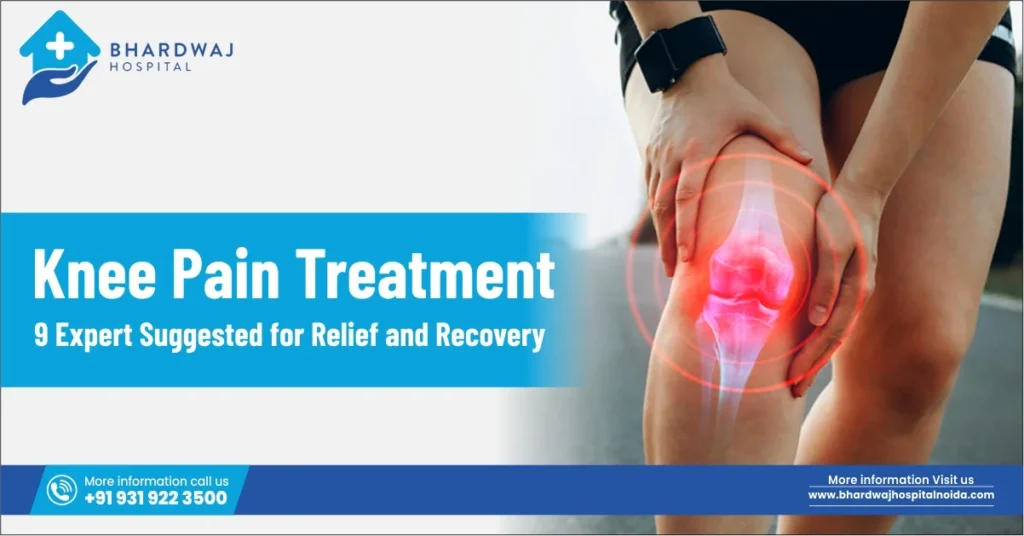
Knee pain is among the most frequent musculoskeletal issues that affect people of all age groups, from youthful athletes to those suffering from degenerative diseases. The cause could be injuries, arthritis, or a medical issue. Knee pain can greatly restrict your mobility and impact your quality of life. Here at Bhardwaj Hospital, one of the best hospitals in Noida, with more than 30 years of medical excellence, our experienced orthopaedic doctors in Noida frequently guide patients to efficient, scientifically based solutions to ease knee pain and rehabilitation.
What is the best treatment for knee pain?
The best method of treating knee pain is determined by its source, severity, and duration. But the majority of orthopaedic experts recommend a multi-pronged treatment that incorporates lifestyle changes as well as physical therapy and, when needed, medical intervention. Below are the 9 best expert-suggested tips, and these are:
-
Rest, Ice, Compression, and Elevation (RICE Therapy)
In the case of knee pain that is acute, resulting from injuries or sudden strains, the RICE method is still the best advice. Resting the knee in question prevents any further injury, and applying cooling packs of ice for 15 minutes a day can reduce inflammation and dull the pain. Bandages for compression help reduce swelling, while elevating the leg above the heart level encourages drainage of fluid. This method is most effective during the initial 48-72 hours following an injury.
-
Physical Therapy and Targeted Exercises
The structured physical therapy is among some of the most efficient non-surgical treatment options for chronic knee pain. A physiotherapist develops a customised workout program for strengthening the muscles around the knee, specifically the quadriceps, hamstrings and calves. This reduces the strain placed directly upon the knee joint. Exercises that require less impact, like straight lunges, squats on the wall and step-ups, are often recommended to increase flexibility and stability without causing pain.
-
Weight Management
Being overweight places immense stress on knee joints. Research indicates that every kilogram of excess weight places roughly 3-4 kilograms of force on the knees each time you step. For those suffering from chronic knee pain, osteoarthritis, and other joint problems, even a small reduction of 5–10 per cent of body weight can cause a dramatic reduction in pain and better joint functioning. A balanced diet, coupled with moderate physical exercise, is the foundation of a sustainable weight-management program.
-
Anti-Inflammatory Medications
The over-the-counter non-steroidal anti-inflammatory drugs (NSAIDs) like ibuprofen and naproxen are often employed to treat minimal to moderate knee discomfort. They help by reducing inflammation and providing some relief for discomfort. However, the long-term usage of NSAIDs could result in cardiovascular and digestive negative effects; it is important to use them under medical supervision. Gels or creams for topical use that contain diclofenac can be a safe option for local pain relief.
-
Corticosteroid or Hyaluronic Acid Injections
For patients who don’t respond to oral medications or physical therapy, intra-articular injections could provide significant relief. Corticosteroid injections can deliver potent anti-inflammatory medications directly into the joint, offering quick relief from swelling and pain, especially when osteoarthritis or rheumatoid arthritis is the cause. Hyaluronic acid (HA) injections, also known as viscosupplementation, help lubricate the knee joint and are especially beneficial for mild to moderate osteoarthritis. The orthopaedic experts in Bhardwaj Hospital carefully evaluate each patient prior to prescribing injections to ensure the best results.
-
Use Of Supportive Devices Like Braces and Orthotics
Braces for knees and orthotic shoe inserts offer structural support and relief from pain. Braces relieve stress on the affected portion of the knee. They also stabilise the joint and stop any abnormal movements that can cause injuries. Different kinds of braces have different functions. The unloader braces are suitable for patients suffering from unicompartmental osteoarthritis. Hinged braces help stabilise after ligament injuries. Correctly fitting orthotics are able to help correct gait imbalances that lead to knee misalignment as well as chronic pain.
-
Hot and Cold Therapy
However, while cold therapy (cryotherapy) is the best choice for injuries with a high risk of swelling, the use of heat therapy is better in chronic conditions like muscle stiffness and arthritis. Applying warming compresses or a heating pad prior to exercise can help loosen muscles and increase the flexibility of joints. The alternation of cold and hot therapy can also increase blood flow and speed up recovery. This easy, at-home method is an excellent addition to other treatment strategies.
-
Platelet-Rich Plasma (PRP) Therapy
Platelet-Rich Plasma (PRP) therapy is a new treatment for regenerative purposes that makes use of the patient’s blood, enriched with growth factors to encourage tissue healing within the joint of the knee. It’s especially beneficial for those suffering from mild to moderate osteoarthritis and tendinopathy, as well as ligament injuries. PRP injections help to stimulate the body’s own repair mechanisms, reducing inflammation, and could reduce the rate of cartilage degradation. Since it is a minimally invasive procedure, it is growing in recognition as a viable option for patients who wish to avoid undergoing surgery.
-
Surgical Intervention — When Conservative Treatment Is Not Enough
If non-surgical therapies fail to give sufficient relief after a few months, the option of surgery may be contemplated. Surgery called ‘arthroscopy’ is a minimally invasive procedure to repair damaged menisci, eliminate pieces of cartilage that are loose or address ligament injuries. If you suffer from severe osteoarthritis and joint injury, partial and total knee replacement provides a long-lasting solution that is safe and reliable to restore mobility and improve the quality of your life. The experienced medical team of Bhardwaj Hospital employs the latest orthopaedic methods to guarantee secure, efficient outcomes for patients in need of operative care.
What is the Permanent Solution for Knee Pain?
Many patients wonder if knee pain is permanently resolved. The answer is simple; it is contingent on the root causes. If you’re suffering from pain due to an injury or a structural issue, a surgical fix and rigorous rehabilitation could provide long-lasting, or even lasting, relief. For degenerative diseases like osteoarthritis, the emphasis is on management rather than curing. The total knee replacement procedure is the most durable treatment for arthritis at the end of its life.
The most effective strategies for long-term relief include keeping an ideal weight, participating regularly in low-impact workouts, eating a diet that is rich with omega-3 fats as well as antioxidants, staying away from high-impact activities that put stress on the knee and undergoing regular appointments with an orthopaedic surgeon. The consistency of these habits is the only way most patients can find a permanent solution.
What is the best recovery for knee pain?
A successful knee rehabilitation program is a combination of multiple components working in harmony. The most effective recovery plan is one that is adapted to each person’s unique health condition, diagnosis, and lifestyle. Here are the key elements of a successful knee rehabilitation:
- Affiliation with a physiotherapy regimen that is progressive in loading.
- A good night’s rest and adequate sleep allow the body to heal damaged tissues.
- Nutritional supplements that are appropriate include vitamin D, calcium and anti-inflammatory foods.
- Regular use of prescribed braces, medications, or other devices is required.
- Regular follow-up appointments are a good way to monitor progress and alter the treatment program.
The ability to persevere is also an essential element of rehabilitation. The process of knee rehabilitation isn’t always simple, and the rush to get back to full-time activity too quickly is a frequent reason for re-injury or setback.
Conclusion
Knee pain is a complicated and frequently multifactorial issue; however, with the correct treatment, most people are able to experience substantial relief and return to an active lifestyle. The answer is either the traditional treatment options, such as rest or physiotherapy, targeted exercises, and nutritional guidance, or more complex treatments like surgery or injections. Early diagnosis and professional guidance can significantly impact the outcome.
At Bhardwaj Hospital, our orthopaedic surgeons dedicate themselves to helping each patient discover the most effective and personalised method for alleviating knee pain and promoting healing. Don’t wait for knee pain to worsen if you or someone close to you is experiencing it. Contact our experts now and begin the journey to long-lasting relief.
FAQs
-
Which Vitamin is Good for Knee Pain?
A variety of vitamins play a vital part in ensuring the health of joints and managing knee pain.
- Vitamin D: Perhaps the most vital vitamin to maintain knee health. Vitamin D is vital to absorbing calcium and mineralisation of bone. A low level of vitamin D has been strongly linked to increased arthritis pain, swelling and a greater risk of the progression of osteoarthritis.
- Vitamin C: As an antioxidant with potent properties, vitamin C supports collagen synthesis, which is the principal structural protein. Healthy vitamin C consumption can shield cartilage from damage caused by oxidative stress and help maintain joint health.
- Vitamin E: This antioxidant helps in reducing oxidative stress in the joints. It also has demonstrated potential for relieving pain that is associated with osteoarthritis.
- Vitamin K: Vitamin K2 specifically helps in directing calcium to bones instead of allowing it to accumulate within joints and soft tissues that are crucial to the prevention of abnormal calcification in the knees.
-
Can Vitamin Deficiency Cause Knee Pain?
Vitamin deficiency is an underlying cause of knee pain, but this connection is frequently neglected. The most prominent nutritional deficit which is linked to knee pain is vitamin D deficiency, which is a major problem in India, particularly in urban areas, despite plenty of sunshine. Vitamin D deficiency causes lower bone density, weakening muscles around joints and increased pain sensitivity, all of which may cause or worsen knee pain.
A similar issue is that a deficiency of vitamin C can impair collagen production, resulting in weakening cartilage and tendons around the knee. Magnesium and calcium deficiencies, while not necessarily vitamins, are a matter of fact and may result in muscle cramps as well as osteoarthritis-related knee pain. If you’re experiencing a strange or constant knee pain, it’s a good idea to ask your physician to assess your levels of minerals and vitamins in a thorough evaluation.















 Call us 9811666123
 info@bhardwajhospitalnoida.com
 Locate us on Google Maps
 Book Appointment