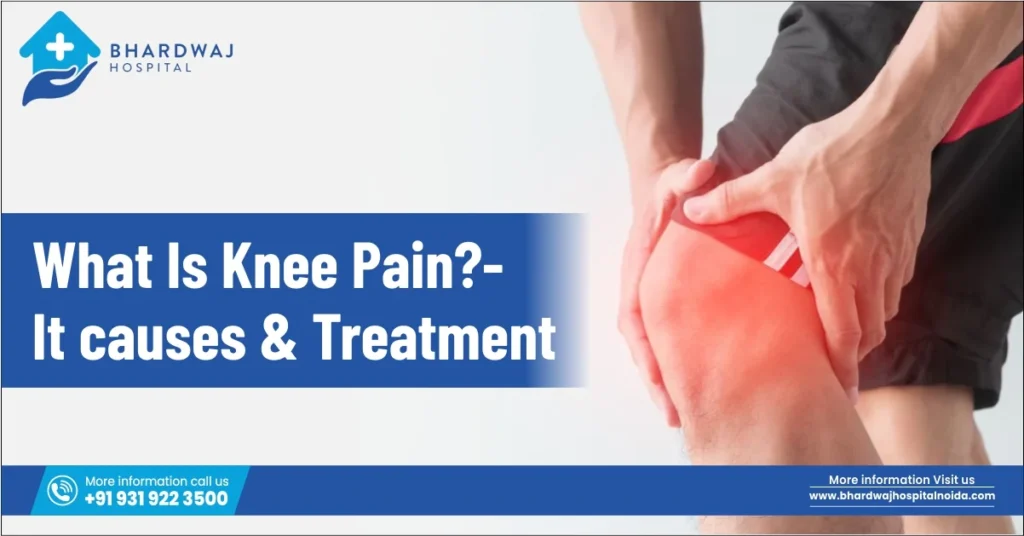
Knee pain is among the most commonly reported health issues in India as well as around the world, and affects people of all ages, from athletes at school to seniors who suffer from age-related joint degeneration. It could be an occasional, dull discomfort or a sharp and debilitating pain that can make even the most basic tasks, like climbing stairs, walking, or getting up from a seat, difficult to complete. At Bhardwaj Hospital, one of the best hospitals in Noida, our experienced experts orthopaedic in Noida have offered world-class treatment for the last 3 decades.
The expert suggests that understanding the causes of knee pain and its treatment can help you lead a pain-free lifestyle. This comprehensive guide has been designed to address all of your major questions.
What Is Knee Pain?
‘Knee pain’ is a term used to describe any discomfort, soreness, or pain that occurs in or near the knee joint, one of the largest and most complicated joints of the human body. The knee is created by the joining of three bones, which are the femur (thighbone), the tibia (shinbone), and the patella (kneecap). The bones are cushioned by articular cartilage and two fibrocartilage pieces in the shape of a “C” called the menisci. These are shock absorbers and improve joint stability.
The joint is held by four major ligaments (ACL, PCL, MCL, and LCL) and is aided by various muscles and tendons, particularly the quadriceps and the hamstrings. If any of these structures are injured, inflamed, or weakened, it can give the knee discomfort. The pain could be restricted to a particular area of the knee or spread throughout the joint based on the cause. Knee pain is often categorized as
- Acute knee pain: it is a sudden onset, often due to injuries or trauma. Examples include meniscus tears, ligament tears, injuries, or fractures.
- Chronic knee pain: this type of knee pain persists over a period of three or more months and is often due to degenerative conditions like osteoarthritis, repetitive injuries, or inflammatory diseases such as rheumatoid arthritis.
Understanding the Anatomy of the Knee
An understanding of the anatomy of the knee can help explain why it’s extremely prone to injury and pain. The knee is more than an instrument of hinges. It permits flexion, rotation, and extension, absorbing the entire weight of the body at every step. The major structural components of the knee comprise:
- Bones- The femur, the tibia, and the patella are the joints. The patella rests in a femoral groove and moves between the tibia and femur during movement.
- Cartilage: Articular cartilage runs along the bone’s surfaces, which allows for effortless, smooth movement. Menisci offer additional cushions between the femur and the tibia.
- Ligaments: Four crucial ligaments (ACL, PCL, MCL, and LCL) connect bones and help in stabilizing them, and prevent excessive movement in any direction.
- Tendons – they connect muscles and bones. The quadriceps and patellar tendon are the most crucial for knee motion.
- Bursae: Small liquid-filled sacs that cushion joints and reduce friction between bone and soft tissue.
Symptoms of Knee Pain
The manifestation of knee pain can vary depending on the causes, but typical symptoms are the following:
- Insistent or frequent discomfort in the front, sides, or back of the knee
- Redness, swelling, or discomfort around the joint
- Stiffness is common, particularly in the morning or following long periods of sitting
- Difficulty in fully bending or straightening the knee
- Instability and weakness
- clicking, popping, or noises that crunch (crepitus) in the course of movement
- The inability to support an excessive amount of weight on the affected leg
Common Causes of Knee Pain
Knee pain could be caused by various ailments. The most frequent causes can be classified under three types, and these are: –
-
Injuries
- ACL (Anterior Cruciate Ligament) Tear – It is one of the most frequent sports injuries, usually resulting from sudden changes in direction or twisting movement. It is a cause of immediate swelling, pain, and joint instability.
- Meniscus Tear: A traumatic or degenerative tear in the meniscal cartilage caused by twisting movements. The symptoms include pain, swelling, and a feeling that the knee is locking.
- Fractures: Cracks that occur within the patella or adjacent bones, mostly due to direct trauma or high-impact accidents.
- Tendon injuries – The patellar or quadriceps tendon may be inflamed (tendinitis) or even rupture completely due to overuse or injury, which can cause pain and impaired movement.
-
Medical Conditions
- Osteoarthritis (OA) – It is the most common knee arthritis type. OA causes the gradual loss of cartilage within the knee joints. It is more prevalent in older people and people who are obese. The pain is usually worsened with exercise and decreases after time off.
- Rheumatoid Arthritis (RA) – Itis an autoimmune disorder where your body’s immune system targets joint linings, causing chronic pain, inflammation, swelling, and ultimately joint destruction if not treated.
- Gout – It is caused by the buildup of uric acid crystals inside the knee joint. This results in sudden, intense bouts of pain and swelling.
- Bursitis: Inflammation of bursae, the tiny cushion of fluid between tendons, bones, and muscles, usually caused by repetitive kneeling or pressure placed on the knee.
- Septic arthritis – It is a joint inflammation that causes sudden swelling, pain, and fever. Medical attention is required immediately because it could cause irreparable joint damage in a matter of hours.
-
Mechanical Problems
- Iliotibial band syndrome – This is a frequent injury from overuse in cyclists and runners, in which the IT band tightens, which rubs on the outside part of the knee, creating painful, lateral, and sharp pain.
- Patellofemoral Pain Syndrome (Runner’s Knee)– The pain is felt around the kneecap due to an imbalance in the muscles, misalignment, or excessive use. Most common in athletes and young adults.
- A patellar dislocation – It occurs when the kneecap slides from its groove, typically to the outside, which causes visible deformity as well as extreme pain.
- Baker’s Cyst (Popliteal Cyst): A swelling that is filled with fluid behind the knee. It is often caused by a cartilage tear or arthritis. It can cause tightness as well as restricted movement.
Risk Factors for Knee Pain
Certain circumstances increase the likelihood of suffering from knee discomfort. Knowing these factors can assist in early detection:
- Extra body weight – Each extra kilo can put pressure of several kilograms onto the knee joint during exercise.
- Injuries – Knee injuries from the past, which increase the risk of injury recurrence
- Involvement in high-impact sports, like basketball, football running, skiing, or football
- Wear and tear – it may be due to age in particular, especially in the 40s and 50s
- Muscle weakness or a lack of flexibility, particularly in the quadriceps and hamstrings.
- Workplace stress – tasks which require standing for long periods or kneeling, as well as heavy lifting
How Is Knee Pain Diagnosed?
A precise diagnosis is essential to an effective treatment for knee pain. Here at Bhardwaj Hospital, our orthopaedic doctors perform a thorough examination that usually includes:
- Review of medical history and symptoms -Duration, location, and the nature of pain
- Physical examination – testing the range of joint motion as well as the joint’s stability and tenderness and swelling
- X-rays – X-Rays are used to evaluate the bone’s structure and find fractures, as well as evaluate the degree of narrowing of joints in arthritis
- MRI (Magnetic Resonance Imaging) – it gives precise photographs of tissues, including ligaments, cartilage and tendons
- CT Scan – A CT scan provides cross-sectional images to identify difficult bone injuries.
- Blood Test or arthrocentesis – In this test joint fluid is taken and analysed to identify Gout, infection or inflammation arthritis
- Bone scan – employed in certain cases to find stress fractures, or bone tumors
Knee Pain Treatment Options
The treatment of knee discomfort is determined by the cause of the pain as well as the severity and general health of the patient and their lifestyle. Treatment options range from basic treatments at home to surgical treatments.
Non-Surgical (Conservative) Treatments
- RICE Therapy (Rest, Compression, Ice, Elevation) – This is the most effective treatment for knee injuries. Applying ice packs for 15 to 20 minutes at a time throughout the day can reduce inflammation. Bandages of compression reduce swelling, and elevation aids in the drainage of fluid.
- Medications: NSAIDs that are available over-the-counter (such as naproxen or ibuprofen) can reduce inflammation and pain. Anti-inflammatory gels applied to the skin are a more secure option for people who have digestive issues.
- The Physical Therapist: A specialized program of physiotherapy strengthens the muscles that support the knee, enhancing the stability of the knee and decreasing the load upon the joint. Training exercises like straight leg raises, step-ups and wall squats are often recommended.
- Weight Management: Getting rid of excess body weight reduces the tension on knee joints in everyday activities, which can lead to substantial pain relief.
- Braces and orthotics – Braces and orthotics for knees provide structural support and relieve the pressure of damaged joint compartments. Inserts for orthotic shoes are able to fix gait irregularities that cause knee alignment issues.
- Heating therapy – This is particularly effective in arthritis and stiffness that is chronic. Warm compresses prior to exercise help relax stiff muscles and increase flexibility.
Injection-Based Treatments
- Corticosteroid injections: Inject powerful anti-inflammatory medications directly into joints, which provides immediate relief from swelling and pain, which is especially beneficial in flare-ups of arthritis.
- Hyaluronic Acid (Viscosupplementation): Lubricating injections that mimic the joint fluid naturally present in healthy knees. They can improve mobility and give relief for six months or over the course of a year.
- PRP Therapy: Platelet-Rich Plasma (PRP) Therapy Regenerative treatment that uses the patient’s blood – filled with growth factors – to speed up tissue healing and decrease inflammation. PRP is becoming increasingly utilized for osteoarthritis in the early stages and tendon injuries.
Surgical Treatments
Surgery is a possibility and the best option when other procedures fail to provide sufficient relief or when there’s substantial structural damage. The highly skilled surgeons at Bhardwaj Hospital provide a variety of surgical options for orthopaedics:
- Arthroscopy – This is a minimally invasive procedure that is used to identify and treat knee injuries that cause internal pain (including tears in the meniscus, cartilage injuries, and ligament repair) by making small incisions with small cameras and instruments.
- Osteotomy – It is a surgical procedure for realigning the knee’s bones by distributing the burden away from the injured area. It is most effective for young, active patients who have early-stage arthritis.
- Partial Knee Replacement – If only one area of your knee has been affected by arthritis, the affected area is repaired with an implant, which preserves the healthy tissue.
- Complete knee replacement (TKR) – A doctor may suggest complete knee replacement in the case of osteoarthritis that is severe or in end-stage; the knee joint in its entirety is replaced using a prosthesis. TKR is among the most effective orthopaedic procedures, ensuring mobility and removing chronic pain.
How to Prevent Knee Pain
Prevention always is more effective than treatment. Although not all knee issues are preventable, below we have listed some preventive measures to reduce the risk of developing knee problems:
- Maintain a healthy weight to lessen the mechanical strain on joints
- Get ready to warm up well prior to exercise and then cool down appropriately afterward
- Build strength in the quadriceps, hamstrings and muscles of the calf through regular exercise
- Find the appropriate shoes for the type of activity you are participating in.
- Beware of overtraining and ensure adequate recovery time between high-intensity workouts
- Don’t ignore the first symptoms of knee pain, and get the medical advice immediately
- Consume a balanced, balanced diet that is rich in Vitamin D and calcium and anti-inflammatory nutrients to help support joint health
When Should You Consult a Doctor for Knee Pain?
Although knee pain can be relieved through rest and remedies at home, you must seek immediate medical attention if you notice the following:
- The severe pain makes weight-bearing impossible
- A significant swelling appears suddenly or persists for a long time
- The knee appears to be off-center
- A pop sound, then joint instability, occurs when the injury occurs.
- A swelling of the knee that is accompanied by fever (which may be an indication of an infection)
- Knee pain that is persistent for more than a couple of days with no improvement, even with rest and prescription medications
Conclusion
The pain of knees is a multifaceted and frequently multi-layered problem; however, it’s far from being unavoidable or untreatable. Understanding the causes of knee pain and identifying the causes and seeking a prompt medical assessment are the key to effective treatment. It doesn’t matter if the issue is joint injury, arthritis or a mechanical issue; medical technology offers many options, including physiotherapy and medications to surgical procedures, to increase function and living quality.
At Bhardwaj Hospital, one of the best multispecialist hospitals in Noida, our highly skilled orthopaedic team is dedicated to providing caring, evidence-based treatment that is tailored to each patient’s specific needs. Should knee discomfort be hindering your day-to-day activities Do not just wait for it to get worse. Call our experts today to begin the journey to better mobility and a more healthy future.















 Call us 9811666123
 info@bhardwajhospitalnoida.com
 Locate us on Google Maps
 Book Appointment