
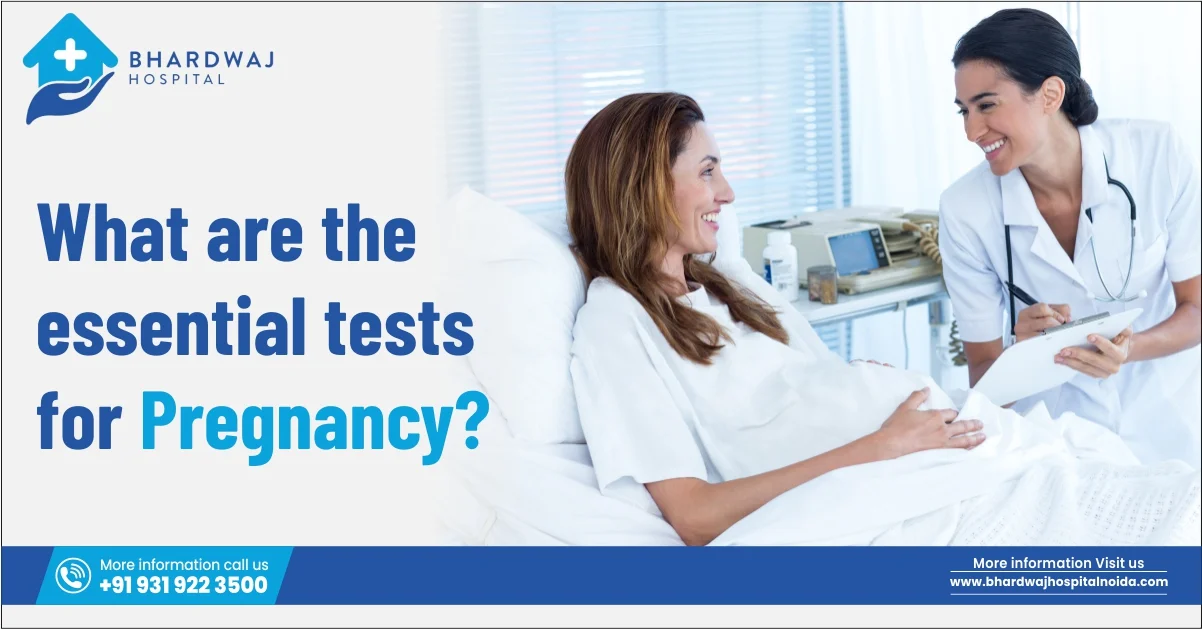
The pregnancy is a serious period that should be monitored on a regular medical basis to ascertain the well-being of both the mother and the unborn child. Home pregnancy tests can establish conception, but medical tests are necessary to monitor the progress of the fetus, identify nutritional deficiencies and complications so that they can be detected early.
The initial weeks and last trimester have a list of recommended tests that can be differentiated into stages that can be used by doctors to suggest the appropriate prenatal care. These tests assist in validating pregnancy, measuring hormone levels, and providing screening for infections and genetic threats. Bhardwaj Hospital is the best Gynecologist in Noida that offers pregnancy care that ensures safe motherhood and good delivery outcomes, with full support for diagnostic services and screening throughout the pregnancy trimesters.
Understanding Pregnancy Testing and Why It Matters
Pregnancy testing does not solely involve verification that a female is pregnant. It is an entire medical procedure that assists in checking the health of the mother and the development of the baby during the entire three trimesters. Mainly, early pregnancy tests are aimed at establishing conception and making sure that the pregnancy is situated within the uterus. The subsequent tests enable the doctor to keep track of fetal development, test key nutrients, and identify risk factors such as gestational diabetes, anemia, thyroid issues, infection, or pregnancy-related hypertension.
The majority of the pregnancy tests are conducted in stages, as the body requires significant hormonal and physiological changes at various stages. To illustrate, during early pregnancy, the hormone levels, such as beta hCG, increase very fast. During the first trimester, testing is required to identify infections and genetic vulnerabilities. In the second trimester, the scans verify the organ formation and the fetus’s structure. Monitoring of the third trimester is an outcome of the growth of the baby, the functioning of the placenta, and the maternal preparedness to deliver.
Pregnancy testing is also used to determine high-risk pregnancies. Women having PCOS, thyroid conditions, diabetes, and miscarriages in the past, or women of mature age, might need some extra screening. Frequent tests will give early alerts, and the medical practitioners will act accordingly. All in all, pregnancy tests are necessary to avoid complications and make sure that the pregnancy develops safely till the birth.
An Overview of The Essential Tests for Pregnancy
Here are the essential tests for pregnancy:
- Early Pregnancy Confirmation Tests (Weeks 3–6)
The first step is pregnancy confirmation, which is done at the preliminary stage. The first one is a home urine pregnancy test. It identifies pregnancy hormone hCG in the urine and is preferable when one misses their period. Nonetheless, the outcomes can be different according to the time and the accuracy of the test. The beta hCG blood test is a sure way of confirmation.
It identifies pregnancy earlier than urine and also determines the level of the hormone in question. Physicians can repeat beta-hCG tests in order to confirm that the pregnancy is proceeding normally. Early ultrasound is also advised in most instances. It establishes the location of the pregnancy and eliminates ectopic pregnancy. It is also able to screen early development and make estimations of gestational age.
- First Trimester Tests (Weeks 6–12)
The most critical one is the first trimester, which involves screening and baseline testing. In order to examine hemoglobin levels, red blood cells, and signs of infection, a Complete Blood Count (CBC) is performed. It can be used to identify anemia common during pregnancy. The blood group and Rh factor test is a necessity to identify Rh-negative mothers to administer injections to avoid complications.
Tests of thyroid profile, such as TSH, T3, and T4, are also of importance since an imbalanced thyroid may also influence the development of the brain of the fetus and the health of the pregnancy. The urine routine and urine culture testing are done to obtain indications of urinary tract infection and to keep track of the health of the kidneys.
Blood sugar screening is also conducted to establish early glucose problems. HIV, Hepatitis B (HBsA), VDRL (syphilis), and Hepatitis C are some of the infection screening tests that are necessary to safeguard the baby during pregnancy or delivery. Rubella immunity testing is a test that focuses on determining whether the mother is immunized against rubella, which has the capability of leading to congenital disabilities.
Genetic screening is also another significant component of first-trimester testing. NT scan and Double Marker tests can be used to determine the risks of chromosomal abnormalities. These first-trimester tests are well scheduled at Bhardwaj Hospital in order to offer a full pregnancy check and early identification of risk.
- Second Trimester Tests (Weeks 13–28)
In the second trimester, it is mainly based on the development of the fetus and the monitoring of maternal health. The most significant test is the anomaly scan, which is also referred to as a Level 2 ultrasound. It is normally performed between 18 and 22 weeks and examines the baby’s organs, growth pattern, and physical development.
Other women are possibly required to take Triple Marker or Quad Marker screening based on their age, medical history, or previous screening outcomes. These are tests that determine genetic risk and abnormality of the fetus.
The Glucose Tolerance Test (OGTT) is another major test that measures gestational diabetes. This typically occurs between 24 and 28 weeks, and this is necessary since untreated gestational diabetes may affect both the mother and the baby.
Doctors can also retest CBC to keep track of anemia; they may also check blood pressure and protein in their urine so as to detect the onset of preeclampsia. In the case of abnormalities that were detected previously, thyroid tests can be retaken.
- Third Trimester Tests (Weeks 28–40)
The third trimester is concerned with the growth of the fetus and delivery preparation. The CBC tests are redone to monitor the level of hemoglobin and platelets, to make sure that the mother is physically fit to give birth. Routine tests of urine are repeated in order to check for infection and protein concentration.
A growth scan or Doppler ultrasound is done to determine the size of the baby, amniotic fluid, and the flow of blood in the placenta. This scan is used to determine growth restriction or low circulation.
Pregnancy-induced hypertension and preeclampsia screening needs to become crucial at this point, in case the blood pressure increases or the urine shows the presence of protein. Blood sugar checks remain in women with gestational diabetes.
Group B Strep testing can be recommended in a few instances. Other pre-delivery tests can take the form of a clotting profile, an ECG, or any other test as per the condition of the patient. Third-trimester monitoring at Bhardwaj Hospital aims to make sure that safe delivery planning is provided and medical assistance can be given in case of any issues.
Conclusion
Pregnancy testing is also important in confirming pregnancy, monitoring the growth of the fetus, and ensuring the health of the mother during all trimesters. Stage-based tests assist in the early detection of anemia, diabetes, infections, and genetic risks. Bhardwaj Hospital provides organized pregnancy screening, the best Gynecologist in Noida, and safe delivery services to have full prenatal testing and professional services of maternity care.















 Message us on Whatsapp
 Call us 9319223500
 info@bhardwajhospitalnoida.com
 Locate us on Google Maps
 Book Appointment