Piles, or hemorrhoids, are one of the prevalent medical conditions that, if not treated promptly, can have a disruptive effect on an individual’s life. The good news is that there are several treatments that are effective and successful in treating the condition. If you are one of the sufferers and looking for the very latest, technique-based, high-success-rate piles surgery, then Bhardwaj Hospital is the right destination for you. We offer a range of surgical treatments like laser and haemorrhoidectomy, stapled haemorrhoidopexy, and rubber band ligation (RBL), to mention a few, and we are committed to ensuring a high success rate in every patient.
Understanding Piles Surgery and Its Success Rate
Before knowing the success rate of the piles, you must know what exactly piles are. Swollen veins in the rectum or anus that cause pain, itching, and bleeding are referred to as hemorrhoids or piles. There are four types of piles, which are
- Internal piles, which are found inside the rectum, in most instances, are usually painless and may bleed.
- Prolapsed piles occur when internal piles bulge out of the anal area, and it’s extremely painful.
- External piles, found under the skin around the anal area, are visible and also painful.
- Thrombosed piles occur when blood clots form in the hemorrhoids.
Piles surgery is considered when traditional treatments, lifestyle alterations, and medications are not effective. Typical indications include:
- Prolonged bleeding or pain in the anal area
- Prolapsed piles cannot be manually pushed back.
- If you have haemorrhoids that have thrombosed or strangulated
- Reoccurrence of the symptoms that affect your regular life
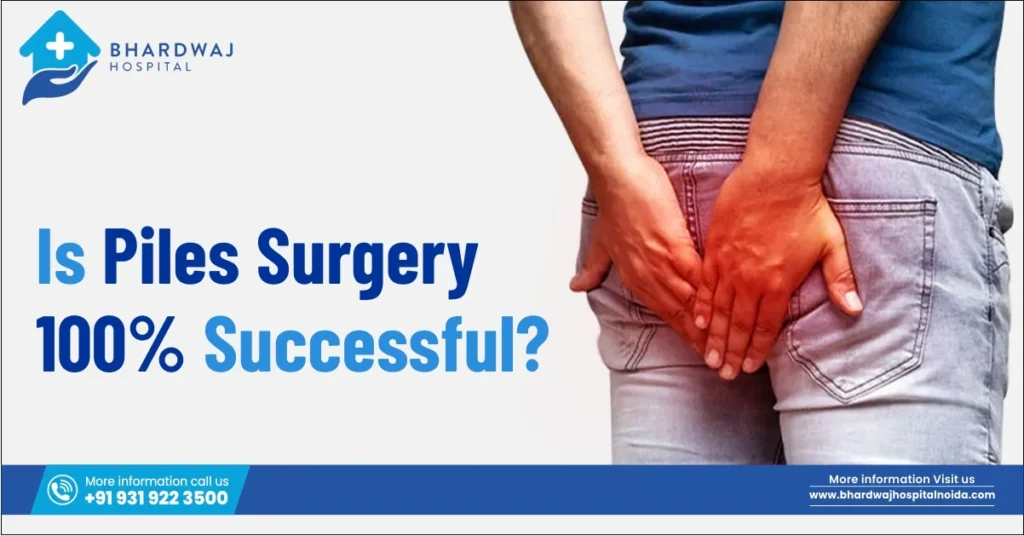
Most pile surgery success rates range from 90% to 95%, but like any medical procedure, 100% success is not guaranteed. However, the exact success rate of the surgery for piles is influenced by the nature of the surgery, the nature of the hemorrhoids, and the general condition of the patient. Hemorrhoidectomy surgery is the best for long-term success; it is also possible to have a variety of laser and staple hemorrhoidopexy treatments, whose recovery is fast, with somewhat different results..
Types of Piles Surgery and Their Success Rates
Every treatment procedure has its own success rate, recovery time, and possibility of recurrence. If you know these treatment options, you can make sound decisions.
Hemorrhoidectomy (Open/Closed)
Hemorrhoidectomy is one of the most trustworthy and successful surgical treatments for grade 3 and grade 4 hemorrhoids. Our hemorrhoid surgeons at Bhardwaj Hospital crucially remove swollen hemorrhoid tissues either through an open technique, where the wound is left to heal naturally, or a closed technique, where the wound is stitched. Hemorrhoidectomy has the highest pile surgery success rate, around 95%, with a very low risk of recurrence. It will take around 2 to 4 weeks for full-time recovery.
Stapled Hemorrhoidopexy
If you have internal prolapsing piles, stapled hemorrhoidopexy surgery is commonly performed. For the repositioning of the prolapse tissue, a circular stepping device is optimised to cut off the blood supply, making it shrink. It also offers less pain and a higher recovery rate, between 85% and 90%, than the traditional hemorrhoidectomy.
Laser Hemorrhoidoplasty (Laser Surgery)
Laser surgery is a new and least invasive therapy that has already been identified as comfortable and accurate. The survival rate of this surgery is 85%-95%, depending on the condition and habits of the patient. The primary advantage of this tool is its lower pain compared to other surgeries, paired with a short hospital stay and a fast recovery. It is highly applicable for patients with grade 1 to grade 3 piles, but in advanced cases, it is combined with other procedures.
Rubber Band Ligation (RBL)
This surgery is ideal for those individuals who are at an early stage of internal piles. In the surgical procedure, a small rubber band is placed at the base of the hemorrhoid, which cuts off the blood supply, and within a few days, it falls off. Effective for grades 1 to 2 piles, it offers a success rate of around 70% to 80%. Although it is fast, not so painful, and requires no hospitalisation, this procedure has temporary benefits, as piles may recur. This is because of an improper lifestyle, which may require multiple sessions or the need to opt for another surgery method.
Therefore, if you choose a proper surgical procedure, you will witness a significant outcome. For expert assessment and advanced pile surgery, visit Bhardwaj Hospital in Noida.
Factors That Influence the Success Rate of Piles Surgery
Pile surgery success rate depends on a number of key factors, which interact to give rise to long-term results and the risk of recurrence.
Patient-Related Factors
It is dependent on the age, weight, dietary habits, and bowel health of a patient. The healing can be influenced by chronic constipation, straining, a low-fibre diet, and diseases such as diabetes. Lifestyle factors such as hydration and physical activity also affect recovery and recurrence.
Surgeon and Technique Factors
The results largely depend on the specialist and the type of procedure used by the surgeon. Choosing the right method of either laser, stapled, or conventional, depending on the grade of piles, is a way of achieving greater success. The use of advanced equipment and proper surgical precision further enhances outcomes. At Bhardwaj Hospital, our experienced surgeons and advanced infrastructure provide a safe and hygienic environment for the treatment of piles.
Post-Operative Factors
It is important to follow the post-surgery instructions. Prevention of complications is possible with a high-fibre diet, sufficient water, stool softeners, sitz baths, and the avoidance of heavy lifting. Follow-ups and bowel regularity minimise the chances of recurring symptoms.
How to Maximise the Pile Surgery Success?
Pre- and post-surgery preparation, along with strict discipline, are the key to maximising the success of a piles surgery.
Before Surgery
Patients are expected to control constipation, stay hydrated, have a high-fibre diet, and do all required diagnostic examinations. Selecting a surgeon with decades of experience and explaining the best procedure to perform, depending on the grade of the pile, also enhances results.
After Surgery
Post-operative care is vital. Dietary instructions, stool softener use, sitz baths, abstinence from straining, and hygiene will lead to easy healing. The patient needs to be active but avoid heavy lifting and go for follow-up visits to prevent complications and the risk of recurrence.
Conclusion
The knowledge of the piles surgery success rate will enable patients to have realistic expectations and make the right choice of treatment method. The success of the procedures is based on the correct selection of the procedure, the skill of the surgeon, and the maintenance of postoperative care. By adopting good lifestyle habits and follow-ups, a majority of patients find relief on a long-term basis and a better quality of life. To have an expert opinion and get a complex treatment of piles, reach out to Bhardwaj Hospital, Noida. Book a consultation now!















 Message us on Whatsapp
 Call us 93192 23500
 info@bhardwajhospitalnoida.com
 Locate us on Google Maps
 Book Appointment