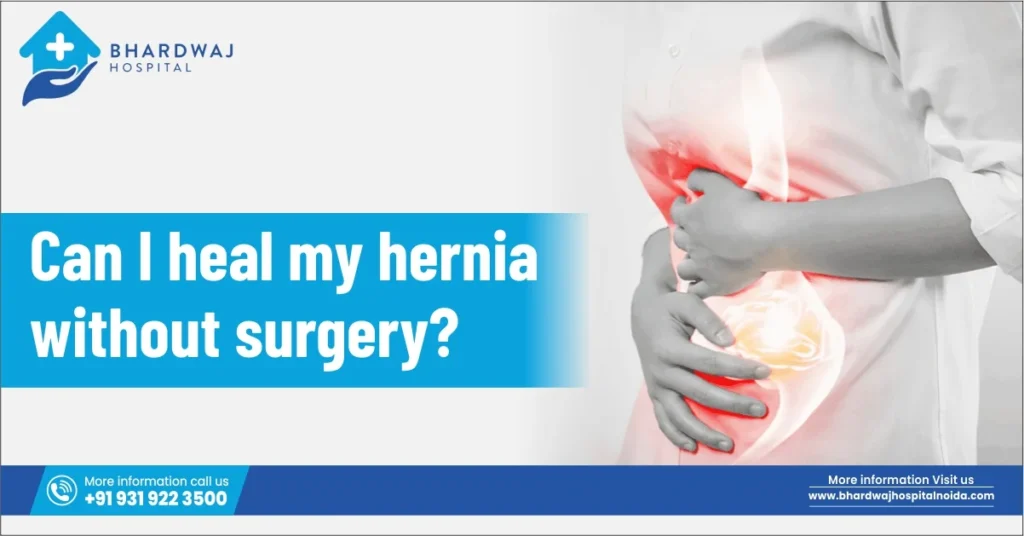
Hearing the word ‘hernia’ can immediately trigger concern. Most of the time, people assume that surgery is inevitable, while others try to identify alternative ways to avoid it altogether.
But a common question that most of our surgeons hear is, “Can a hernia heal on its own without surgery?” The short answer to that is that most hernias do not heal naturally. However, the full picture is a lot more nuanced.
If you are curious about what a hernia is and whether you can heal it without surgery, this detailed guide from our leading experts at Bhardwaj Hospital will answer all your questions. For more information about hernia treatment in Noida, consult us.
What is a Hernia (and Its Types)?
A hernia occurs when an internal organ or tissue pushes through a weak spot in the surrounding muscle or connective tissue. The most common scenario involves part of the intestine pushing through weakened abdominal muscles, creating a noticeable bulge.
The thing about hernia is that they can develop gradually over time or appear suddenly after physical strain. Some of them usually remain small and painless initially, but it is rare for them to disappear or heal on their own.
Some of the common types of hernia include:
- Inguinal hernia —this is the most common type of hernia in men. It occurs in the groin area, especially when the tissue pushes through a weak point in the abdominal wall.
- Umbilical hernia – The second most common hernia is the umbilical hernia, which occurs near the belly button and is common in infants but can also affect adults.
- Hiatal hernia – This type of hernia occurs when part of the stomach pushes through the diaphragm into the chest cavity.
- Incisional hernia – As the term suggests, an incisional hernia develops at the site of a previous surgical incision where the abdominal wall has weakened.
- Femoral hernia – Although this type of hernia is less common, it is often more severe and is likely to cause complications and typically appears near the upper thigh region.
Each type of hernia requires a personalised treatment and surgical approach, which is exactly what our surgeons prioritise at Bhardwaj Hospital in Noida.
Can a Hernia Heal Without Surgery?
We have briefly mentioned before that a hernia doesn’t heal naturally. It is not like a muscle strain or injury that might repair itself. A hernia usually involves a defect or opening in the muscle wall, which requires surgical intervention for a permanent cure.
The reason why most patients “feel” their hernia is “improving” is because the symptoms might temporarily improve. The bulge might disappear when lying down or when pressure on the abdomen reduces. Also, the pain might fluctuate based on the patient’s activity levels. This gives the illusion that the hernia might be “repairing” itself.
However, despite all of that, an underlying weakness remains. If you don’t receive proper and timely treatment, a hernia can gradually enlarge over time and can lead to complications, too. This is one of the reasons why our surgeons at Bhardwaj Hospital emphasise the need for timely consultation, followed by a personalised treatment plan to reduce risks and improve recovery time significantly.
Are There Any Situations Where Hernia Surgery Can Be Delayed?
When it comes to permanently healing a hernia, surgery is the only viable option. However, there are instances where you might benefit from non-surgical management initially. Some of these instances are:
-
Small hernias with minimal symptoms
If the hernia is small and not causing significant pain or discomfort, doctors may suggest a “watchful waiting” approach. This involves regular monitoring to ensure the condition does not worsen.
However, even during this period, our surgeons will recommend that you avoid heavy lifting, maintain a healthy weight, manage chronic cough or constipation and avoid activities that could be increasing your abdominal pressure.
This watchful monitoring won’t heal or cure your hernia, but it might slow down or prevent further progression.
-
Patients with high surgical risk
There are instances where some patients have medical conditions that make surgery temporarily unsafe for them. Even in such instances, you might be recommended conservative management until the patient qualifies for the surgery.
-
Hernia support garments
Hernia belts or trusses are sometimes used to support the weakened area. These garments apply gentle pressure to keep the bulge in place and reduce discomfort during daily activities.
However, these supports should only be used under medical supervision, as improper use may cause complications.
Even with these “non-surgical” approaches, ongoing monitoring is a must. This is why expert evaluation at a trusted healthcare facility, such as Bhardwaj Hospital, is crucial for determining the safest approach.
What are the Risks of Ignoring a Hernia?
You might see a small protrusion and ignore it, thinking it is not something serious or something to worry about. This is where you might be wrong.
One of the biggest concerns with untreated hernias is that they rarely stay the same. In many cases, they gradually grow larger over time.
So, ignoring a hernia can often lead to a variety of complications, including:
- Incarcerated Hernia: This occurs when the protruding tissue becomes trapped and cannot be pushed back into the abdomen. It may cause persistent pain and discomfort.
- Strangulated Hernia: A strangulated hernia is a serious medical emergency. It occurs when the blood supply to the trapped tissue is cut off.
Some of the symptoms of these complications include:-
- Severe pain
- Nausea or vomiting
- Redness or discoloration around the bulge
- Fever
When you leave your hernia untreated, and it becomes strangulated, it can often lead to tissue damage and life-threatening complications. In such cases, we urge you to rush the patient to Bhardwaj Hospital’s Emergency Department for immediate care and medical attention.
When Surgery Becomes the Best Option for Your Hernia?
Most doctors recommend surgery once a hernia begins to cause symptoms or increase in size. Surgical repair addresses the root cause by closing the weakened area of muscle.
What’s amazing to know is that modern hernia repair is far safer, more advanced, and less invasive than a lot of patients assume. In many cases, it is performed using minimally invasive techniques that allow faster recovery and less postoperative discomfort.
The following are the best surgical options to consider:
-
Open Hernia Repair
This is the most common surgical intervention for repairing your hernia. In this, our surgeon will make a small incision near the hernia and push the protruding tissue back into place. The muscle wall is then reinforced, often using surgical mesh to strengthen the area.
-
Laparoscopic Hernia Repair
As the name suggests, this is a minimally invasive approach that uses small incisions and a camera-guided instrument. The patients usually have a smaller surgical scar, reduced pain and faster resuming of normal activities.
Our surgeons at Bhardwaj Hospital will first discuss your symptoms and general health during the initial consultation. Following that, we will recommend the most appropriate technique based on the type and severity of the hernia.
What are The Benefits of Early Hernia Treatment?
Much like the risks associated with delayed hernia treatment, there are certain benefits when you get your hernia treated on time.
Some of these benefits include:-
- It prevents complications of incarceration or strangulation.
- It ensures faster recovery. Smaller hernias are generally easier to repair and may require shorter recovery times.
- It provides an improved quality of life. Many patients notice immediate relief from discomfort and pressure after surgical repair.
- It lowers long-term health risks. Addressing the problem before it worsens prevents additional stress on surrounding tissues and organs.
If you are experiencing any of the following symptoms:-
- Sudden or severe pain in the hernia area
- A bulge that becomes firm or cannot be pushed back
- Nausea or vomiting along with hernia pain
- Fever or redness near the bulge
- Rapid increase in hernia size
It is indicative that your hernia requires immediate attention and treatment. We urge you to consult our surgeons at Bhardwaj Hospital without any delay in such cases.
Permanent Relief with Hernia Repair at Bhardwaj Hospital!
While the idea of healing a hernia through diet or exercise is appealing, the clinical reality is that a mechanical hole in the abdominal wall requires a structural fix. Non-surgical methods are excellent for managing symptoms and preparing your body for a healthy recovery, but they cannot close the gap.
If you have noticed a bulge or are experiencing discomfort, it is time for a professional evaluation. Our surgical team at Bhardwaj Hospital, Noida, offers comprehensive diagnostics and advanced surgical options tailored to your lifestyle.
Schedule a consultation with our surgeons at Bhardwaj Hospital to receive expert evaluation and advanced treatment options tailored to each patient’s needs.













 Call us 9811666123
 info@bhardwajhospitalnoida.com
 Locate us on Google Maps
 Book Appointment