Knee pain can take over your life in ways you don’t realize until daily movements start to feel difficult. When climbing stairs, morning walks, or even sitting down becomes uncomfortable, it’s usually a sign that the knee joint is wearing out faster than it should.
For a lot of the patients, osteoarthritis is the primary reason behind this change. But, the truth is that not every patient requires a full knee replacement to restore knee functionality. In many cases, the damage is restricted to just one part of the knee. When that happens, partial knee replacement becomes a strong and effective alternative.
Wondering how partial knee replacement could help you deal with stubborn knee pain? This elaborate guide will walk you through the details.
What Partial Knee Replacement Really Is?
Also known as unicompartmental knee replacement, partial knee replacement (PKR) focuses on resurfacing only the damaged compartment of the knee.
To better understand PKR, we need to understand the anatomy of the knee. The knee is divided into three main compartments:-
- Medial Compartment
- Lateral Compartment
- Patellofemoral Compartment
In most cases of severe arthritis, the damage is widespread, which explains why you might need a total knee replacement (TKR), which replaces all three damaged compartments. However, for a significant number of patients, the damage, usually from osteoarthritis, is isolated to just one compartment, most often the medial one. This is where partial knee replacement is recommended.
PKR focuses exclusively on replacing the damaged cartilage and bone surfaces of only one compartment, typically the medial or lateral.
Are You an Ideal Candidate for Partial Knee Replacement?
Partial knee replacement is a highly effective procedure but strict patient selection is vital for long-term success. Our specialists at Bhardwaj Hospital thus ensure the patients meet the following criteria to determine the right candidature:-
- The patient’s arthritis must be confined to only one compartment of the knee, confirmed through X-rays and potentially other imaging.
- The ACL and PCL, which are crucial for knee stability, must be healthy and fully functioning.
- The patient should have a relatively good range of motion in the knee joint before surgery, with minimal stiffness.
- PKR is typically reserved for osteoarthritis, not inflammatory conditions like Rheumatoid Arthritis, which tend to affect the entire joint.
- While once reserved for older, less active patients, modern implant designs and techniques, often including robotic assistance, have expanded its applicability to younger, more active individuals who wish to maintain a high-impact lifestyle.
If you fit into these criteria, our surgeons will then determine the next steps in the partial knee replacement surgery for you.
What Are Some Common Conditions That Lead to Partial Knee Replacement?
Sometimes, the pain and stiffness in the knees can come out of nowhere, leaving you with a common question, “What necessitates the need for a partial knee replacement?”
The most common reason for this surgery is isolated osteoarthritis, where the cartilage deterioration occurs in only one compartment. Due to friction and wear and tear over time, it causes pain, stiffness and swelling, affecting a patient’s quality of life.
Another potential cause is due to cartilage injuries or early-stage degenerative joint disease, which makes one part of the knee wear out faster than the others. Also, if you have a history of injury, it can also accelerate degeneration in a specific area in the knees, affecting its full range of motion.
What’s important to understand is that this surgery is designed for targeted damage. If the knee has widespread arthritis, severe deformities, ligament tears or inflammatory conditions like rheumatoid arthritis, partial replacement is usually not recommended.
Our orthopaedic team at Bhardwaj Hospital guides patients through these distinctions clearly so you can make an informed decision based on accurate medical insight.
The Partial Knee Replacement Procedure: What to Expect?
Once you have been confirmed for a half knee replacement, you might be curious about the dos and don’ts and what to expect before, during and after the surgery (in terms of recovery).
Partial knee replacement is a precision-driven surgery, which usually takes less time than total knee replacement. It is commonly performed under regional anesthesia (numbing the lower body) combined with sedation, though general anesthesia is also an option.
Here’s what you can expect throughout the procedure:
1. Pre-operative planning
One of the key factors that drive the success of a partial knee replacement is a comprehensive pre-operative planning. At Bhardwaj Hospital, it uses the following advanced imaging and planning tools:
- Comprehensive X-rays and sometimes MRI or CT scans are used to precisely map the extent of the damage and the unique anatomy of the patient’s knee.
- Techniques like Robotic-Assisted Surgery have become transformative in PKR. These systems allow the surgeon to create a virtual 3D model of the knee before the operation.
2. Steps of the surgery
On the day of the surgery, the operation follows a carefully executed sequence:
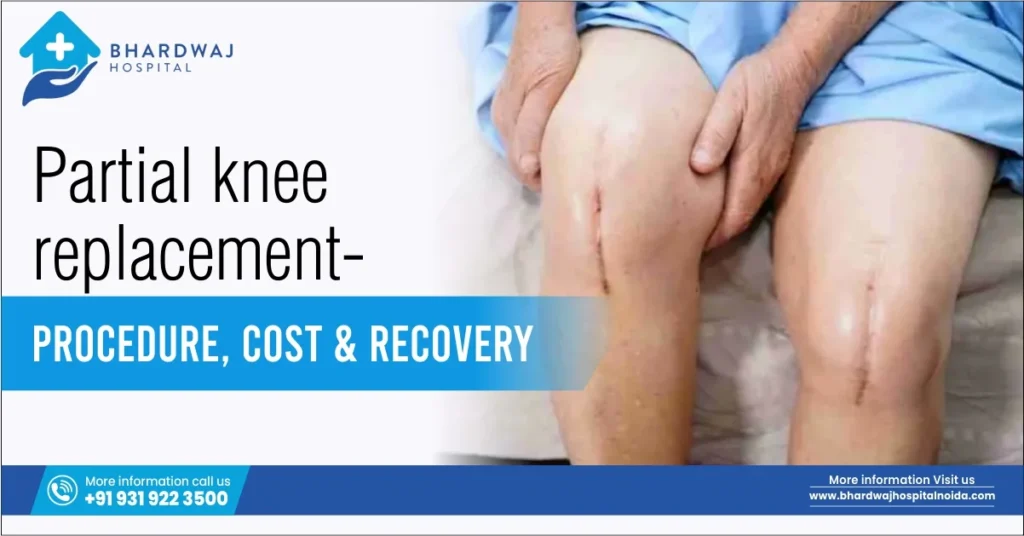
- After anesthesia, a small, carefully placed incision, often about 3 to 5 inches long, is made over the affected compartment.
- The surgeon gently moves the muscles and surrounding soft tissues aside to expose only the damaged compartment.
- Using the precision guidance of the robotic system or specialised instruments, the surgeon removes the damaged cartilage and a minimal amount of underlying bone from the surfaces of the thigh bone (femur) and shin bone (tibia) in the arthritic compartment. The healthy bone and ligaments are deliberately preserved.
- The prosthetic components, including a metal cap for the femur and a metal baseplate for the tibia, separated by a high-grade plastic (polyethylene) spacer, are inserted and secured.
- The surgeon checks the alignment, stability, and range of motion of the newly implanted joint to ensure it functions perfectly before closing the incision.
- Lastly, once the surgeon is happy with the entire surgery, the incision is closed, either with staples or sutures and a dressing is applied. The patient is then wheeled into the recovery room for further monitoring until the anesthesia wears off.
Recovery Timeline and What to Expect at Each Stage?
Right after the surgery, you will be in the recovery room where your vitals will be monitored as the anesthesia wears off. At this point, pain management is also administered early to ensure that you are comfortable.
Depending on how you respond after the surgery, physiotherapists will visit you either on the same day or the next morning to help you take your first steps with proper support and assistance. Early movement is crucial to prevent stiffness and also minimises the risks of blood clots.
As for the recovery timeline after partial knee surgery, here’s a breakdown of the same:
| Recovery Phase | Timeline | What to Expect | Key Goals | Recommended Activities / Care |
| Immediate Post-Op | Day 0 – Day 2 | Mild pain and swelling are normal. You may begin walking with support the same day or the next morning. The hospital team monitors vitals and guides the first movement. | Prevent stiffness, control pain, and ensure safety while walking. | Guided walking with support, pain medication, ice therapy, and basic ankle and foot mobility exercises. |
| Early Recovery | Week 1 – Week 2 | The swelling gradually comes down. You walk more confidently with or without a walker. Sutures are healing well. Physio focuses on bending and straightening the knee. | Improve mobility, initiate muscle strengthening, and increase walking distance. | Regular physiotherapy, gentle knee bending exercises, quad and hamstring activation, short walks, and proper wound care. |
| Strength Building Phase | Week 3 – Week 6 | Knee movement improves. Pain is much lower. You can climb stairs slowly, drive short distances, and resume basic household activities. | Increase in knee strength, enhance balance, and improve range of motion. | Strength training, stationary cycling, step-up exercises, balance work, and a gradual increase in daily activities. |
| Functional Independence | Week 7 – Week 12 | Most people return to routine activities. Knee feels stable, walking is comfortable, and stamina improves. Swelling is minimal. | Restore full functional mobility, boost stamina, and improve joint stability. | Outdoor walking, advanced physio routines, low-impact exercises like swimming or elliptical, and continued strengthening. |
| Long-Term Recovery | 3 Months – 1 Year | Knee feels natural with restored flexibility. The implant settles well. Patients return to their regular routines and engage in low-impact recreational activities. | Maintain joint health, build long-term strength, and ensure implant longevity. | Regular exercise, weight management, avoiding high-impact sports, and periodic follow-ups with the orthopedic team. |
Every aspect of your recovery will be explained in detail by our surgeons at Bhardwaj Hospital so you know how to take control of your healing after the surgery.
Cost Considerations for Partial Knee Replacement in Noida
The average cost of a partial knee replacement in Noida ranges from ₹1.5 lakh to ₹3.5 lakh, depending on numerous factors like the hospital’s infrastructure, surgeon’s expertise, diagnostic tests, medication, implant quality and hospital stay.
Our surgeons at Bhardwaj Hospital will provide you with a detailed cost breakdown after your consultation and before the surgery to ensure 100% transparency. The cost estimate will itemise all potential expenses, including the cost of the implant, surgeon’s fee, anesthesia, hospital stay, and initial post-operative physiotherapy, to avoid any surprises.
Step Towards a Pain-Free Life with Bhardwaj Hospital!
If chronic knee pain, especially if concentrated in one area of the joint, is holding you back, it’s time to explore whether partial knee replacement is the right solution for you. It offers the promise of pain relief, restored function, and a quicker return to the activities you love, all while preserving the maximum amount of your natural knee.
Schedule a consultation with one of our best partial knee replacement surgeons at Bhardwaj Hospital in Noida.
We will conduct a thorough examination, review your imaging, and discuss all your treatment options, giving you a clear path forward.














 Call us 9811666123
 info@bhardwajhospitalnoida.com
 Locate us on Google Maps
 Book Appointment