Choosing the right surgical procedure is an important decision for every patient. With advancements in modern medical technology, surgeons now have different options to perform operations safely and effectively. Two commonly used approaches are Laparoscopic Surgery and Open Surgery.
Both procedures are performed to treat various medical conditions, including hernia, gallbladder stones, appendix problems, and other abdominal conditions. However, they differ in terms of surgical technique, incision size, recovery time, and post-operative care.
So, which one is better – laparoscopic surgery or open surgery? Let’s understand the differences to help you make an informed decision.
What Is Laparoscopic Surgery?
Laparoscopic surgery, also known as minimally invasive surgery or keyhole surgery, is an advanced surgical technique in which the surgeon performs an operation through small incisions in the abdomen.
During this procedure, a thin instrument called a laparoscope, equipped with a small camera and light, is inserted through one of the incisions. The camera displays images of the internal organs on a monitor, allowing the surgeon to perform the operation with precision using specialized surgical instruments.
Benefits of Laparoscopic Surgery
Some of the major benefits of laparoscopic surgery include:
- Smaller Incisions: The procedure requires only a few small cuts instead of one large incision.
- Less Post-Operative Pain: Many patients experience less pain after surgery compared to traditional open surgery.
- Faster Recovery: Patients may return to their normal daily activities sooner, depending on the procedure and their health.
- Shorter Hospital Stay: In many cases, patients can go home earlier.
- Minimal Scarring: Smaller incisions generally result in less visible surgical scars.
- Lower Risk of Wound Complications: Smaller surgical wounds may reduce the risk of certain wound-related complications.
What Is Open Surgery?
Open surgery is a traditional surgical technique in which the surgeon makes a larger incision to directly access the affected organ or area of the body.
This approach allows the surgeon to view and access the surgical area directly. Open surgery is commonly performed for complex medical conditions, emergency situations, and cases where minimally invasive surgery may not be suitable.
Benefits of Open Surgery
Open surgery also offers several important advantages:
- Direct Access: Surgeons can directly view and access the affected organ or tissue.
- Suitable for Complex Cases: It can be more appropriate for complicated surgical conditions.
- Better Surgical Control in Certain Situations: It allows surgeons to manage extensive tissue involvement, bleeding, or unexpected complications.
- Useful in Emergency Situations: It may be necessary when immediate and extensive surgical access is required.
- Widely Established Technique: Open surgery has a long history of successful use across different surgical specialties.
Laparoscopic Surgery vs. Open Surgery: Key Differences
Understanding the differences between these two procedures can help patients discuss the most suitable treatment option with their surgeon.
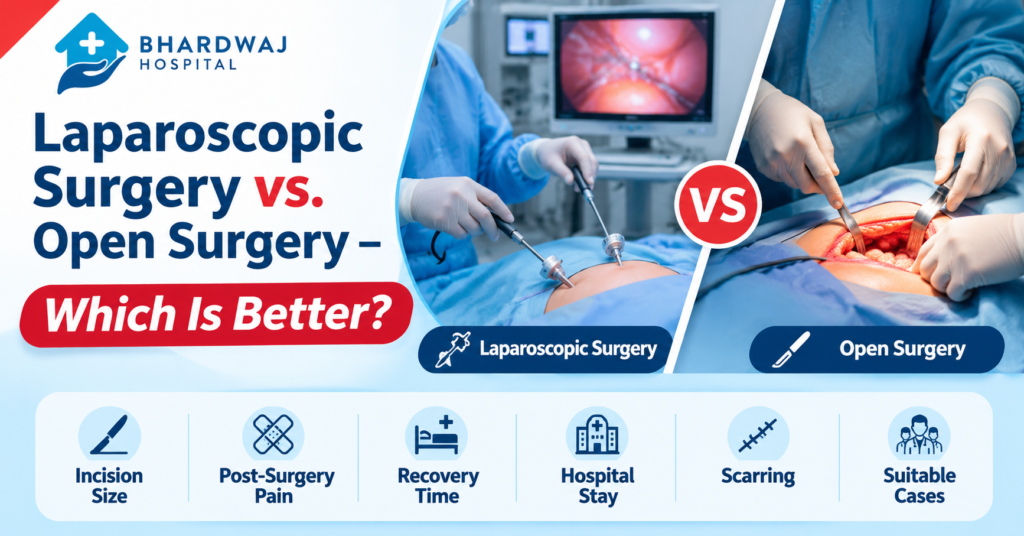
| Comparison | Laparoscopic Surgery | Open Surgery |
| Incision Size | Small incisions | Usually one larger incision |
| Surgical Technique | Camera and specialized instruments | Direct access to the surgical area |
| Post-Surgery Pain | Often less | May be more |
| Recovery Time | Often faster | May take longer |
| Hospital Stay | Often shorter | May be longer |
| Scarring | Usually minimal | Usually more visible |
| Suitable Cases | Many routine and selected complex procedures | Complex, emergency and selected cases |
Note: These are general comparisons. Actual outcomes depend on the type of surgery, patient’s medical condition, and the surgeon’s assessment.
Which Conditions Can Be Treated Through Laparoscopic Surgery?
Laparoscopic surgery is commonly used to treat several abdominal and digestive system conditions.
Some examples include:
- Gallbladder Stone Surgery: Laparoscopic cholecystectomy is commonly performed to remove the gallbladder affected by stones.
- Hernia Surgery: Selected types of hernia can be repaired using minimally invasive techniques.
- Appendix Surgery: Laparoscopic appendectomy is used to remove an inflamed appendix.
- Certain Abdominal Conditions: Selected abdominal procedures can be performed laparoscopically depending on the patient’s condition.
- Diagnostic Laparoscopy: It may help doctors examine internal abdominal organs when further diagnosis is required.
When Is Open Surgery a Better Option?
Although laparoscopic surgery offers several benefits, it may not be suitable for every patient.
A surgeon may recommend open surgery in situations such as:
- Severe infection or extensive inflammation.
- Complicated or large hernias.
- Previous abdominal surgeries that have caused significant internal adhesions.
- Certain emergency surgical conditions.
- Cases where laparoscopic surgery cannot be performed safely.
- Situations where the surgeon needs better direct access to the affected area.
In some cases, a laparoscopic procedure may also need to be converted into open surgery to ensure patient safety.
Is Laparoscopic Surgery Safer Than Open Surgery?
Laparoscopic surgery is generally associated with smaller incisions, less post-operative pain, and faster recovery for many suitable procedures.
However, it does not mean that laparoscopic surgery is always safer or better than open surgery.
Both techniques have potential risks, including bleeding, infection, injury to nearby organs, and complications related to anaesthesia.
The safest approach depends on several factors, including:
- The patient’s age and overall health.
- The type and severity of the medical condition.
- Previous surgical history.
- The complexity of the procedure.
- The surgeon’s experience and expertise.
Therefore, patients should always consult an experienced surgeon before deciding on a surgical procedure.
How Long Does It Take to Recover After Surgery?
Recovery time varies depending on the type of operation, the patient’s health, and whether any complications occur.
Generally:
- After Laparoscopic Surgery: Many patients resume light daily activities within a few days, with full recovery taking longer depending on the procedure.
- After Open Surgery: Recovery may take several weeks, depending on the size of the incision and complexity of the operation.
Patients should follow their surgeon’s instructions regarding medication, wound care, diet, physical activity, and follow-up visits.
How to Choose the Right Surgical Procedure?
Choosing between laparoscopic and open surgery should always be based on proper medical evaluation rather than personal preference alone.
Before undergoing surgery, consider discussing the following questions with your doctor:
- Is laparoscopic surgery suitable for my medical condition?
- What are the benefits and risks of both procedures?
- How long will my recovery take?
- Will I need to stay in the hospital?
- What precautions should I follow after surgery?
An experienced general surgeon can evaluate your condition, explain the available treatment options, and recommend the most appropriate surgical approach.
Conclusion: Laparoscopic Surgery or Open Surgery – Which Is Better?
Both laparoscopic and open surgery play an important role in modern healthcare. Laparoscopic surgery offers advantages such as smaller incisions, less post-operative pain, minimal scarring, and faster recovery for many suitable patients.
On the other hand, open surgery remains an important and effective option for complex cases, emergencies, and situations where minimally invasive surgery may not be appropriate.
The best surgery is not necessarily the one with the smallest incision, but the one that provides the safest and most effective treatment for the patient.
If you are experiencing gallbladder stones, hernia, appendix problems, or other surgical conditions, consult an experienced general surgeon to understand your treatment options.
Consult the General Surgery Team at Bhardwaj Hospital, Noida
At Bhardwaj Hospital, Noida, patients can consult experienced medical professionals for the evaluation and management of various general surgical conditions. The surgical team can guide patients regarding suitable treatment options based on their individual medical needs.
For consultation and appointments:
Bhardwaj Hospital, Noida
Address: NH-1, Sector-29, Noida
Phone: +91-9811666123
Email: info@bhardwajhospitalnoida.com
Disclaimer: This blog is intended for general health information and educational purposes only. It should not be considered a substitute for professional medical advice, diagnosis, or treatment.